 ADHD OS
Stuck in Late-Night Hyperfocus? How to Gently Unplug Your ADHD Brain and Go to Sleep
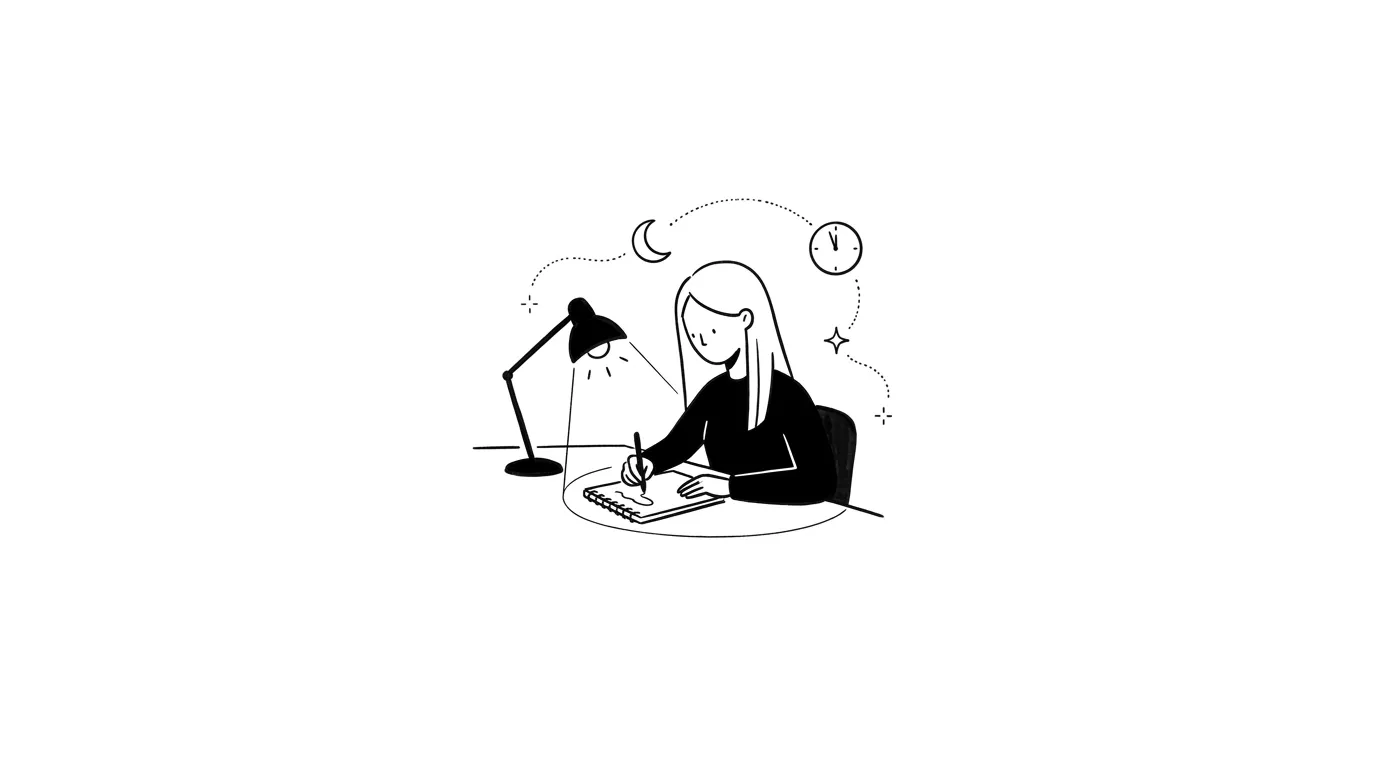
Why is it so hard to concentrate during the day, yet when midnight hits, you enter a state of extreme hyperfocus, coding or writing until 4:00 AM with wide-awake eyes? This is not just being a “night owl”; it is a delayed melatonin release and spontaneous dopamine compensation during distraction-free hours. Learn how to establish a gentle rhythm tracking routine to unplug safely.
For many ADHD brains, late night is the only sanctuary for focus.
There are no Slack messages, no family distractions, and no cognitive pressure to start. You open a document and flow starts. You tell yourself: “I will sleep in five minutes.”
Then you look up, and the sky is turning grey.
When you force your screen shut and lie in bed, your brain’s “CPU” continues to spin at 200 mph, holding all the active task parameters you were just excited about. You watch the clock tick past 5:00 AM, drowning in anxiety.
While productive, this late-night hyperfocus loop destroys your executive energy for the next day.
We must learn to manage our energy and employ energy-flow adaptation to build a landing strip for sleep, rather than forcing a harsh crash shutdown.
The Gentle Unplug: A 3-Step Bedtime Landing
Slowing your brain down from hyperfocus requires a gradual runway:
1. Establish a Physical Time Signpost
When you start a late-night session, never use a ticking countdown alarm. Use the Focus Clock in ADHDOS to set a “focus until” target (e.g., “focus until 11:30 PM”). When it triggers, the clock uses a soft glow and vibrations to nudge you: the runway is ending. You don’t have to quit immediately, but you know it is time to slow down.
2. Ritualize a “Brain Backup”
Often we can’t stop because of the fear: “If I sleep now, all my ideas will vanish by morning.” Before closing your laptop, spend 2 minutes dumping your working memory: write down the next sentence you plan to type, or bullet the next step at the very top of your draft. Once your brain feels the data is safe, the prefrontal load lifts, allowing your mind to exit the active work cycle.
3. Somatic Reset: Enter the Breath Orb
If your mind is still racing when you lie in bed, do not lie there trying to force sleep. Open the Breath Orb in ADHDOS and set your phone screen to minimum brightness. Breathe with the expanding and contracting orb for 2 minutes. Slowing your heart rate signals safety to your nervous system, physically bringing down your brainwave frequencies so you drift off naturally.
Late-night inspiration is a gift, but do not burn tomorrow’s dopamine to pay for it. Design a landing strip, take off in flow, and touch down in peace.
Quick Q&A
Why do I only get inspired and focused at midnight?
ADHD is linked to a circadian phase delay, meaning melatonin release occurs 1.5 to 2 hours later than in neurotypical peers. Additionally, late night has zero notifications and low environmental noise, reducing the cognitive load required to suppress distractions.
What if I am already trapped in late-night hyperfocus and cannot stop?
Do not force a sudden exit, which triggers deprivation anxiety. Use the 'good-enough backup': write down 'Tomorrow start here: [insert next action]' in your file, physically shut the lid, and turn off your lights immediately.
Recommended Reading
Owning the Night: Understanding ADHD Delayed Sleep Phase and a Low-Friction Night Routine
Struggling to sleep at night and drag yourself up in the morning? It might not be screen addiction, but rather ADHD Delayed Sleep Phase Syndrome. Learn the neurobiology of night owls and a gentle, low-willpower wind-down routine.
Beyond the Deficit: 3 Cognitive Superpowers of the ADHD Brain
ADHD is more than distraction and procrastination. Crisis-mode clarity, cross-domain associative thinking, and interest-driven hyperfocus are real cognitive advantages backed by neuroscience. Learn how to leverage them—and how AI tools can amplify these strengths without becoming a new trap.
How to Manage ADHD Hyperfocus and Escape the Autistic Burnout Loop
Science-backed strategies to manage ADHD hyperfocus, rebuild time perception, and prevent exhaustion using visual tools.