 ADHD OS
Beyond the Deficit: 3 Cognitive Superpowers of the ADHD Brain
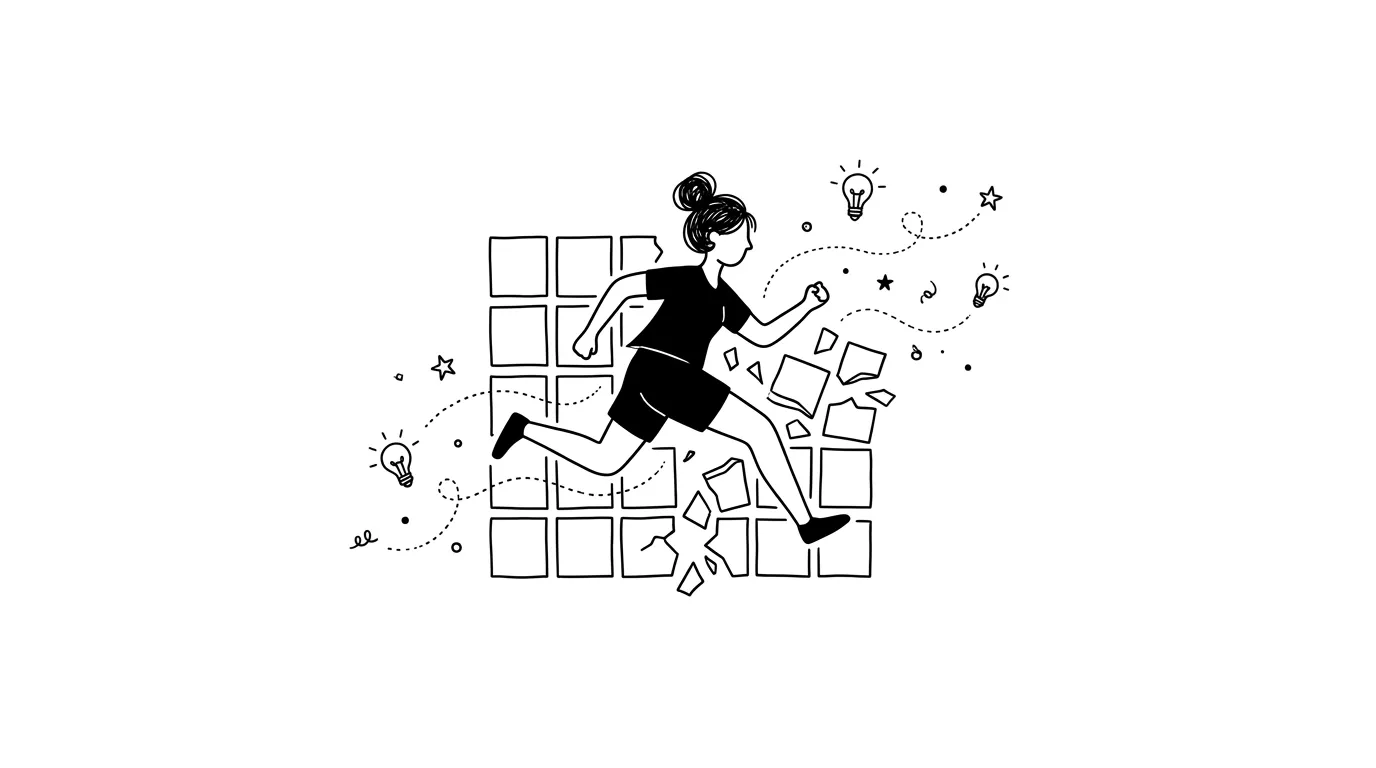
The ADHD brain stays calm in chaos, builds unexpected cross-domain connections, and locks into intense focus when interest ignites. These aren’t bugs—they’re features. This article unpacks the neuroscience behind three cognitive advantages and explores how AI tools can amplify them without becoming a new distraction trap.
You’ve heard the story a hundred times. ADHD means you can’t focus. You can’t sit still. You can’t get it together.
Your elementary school teacher wrote “lacks concentration” on your report card. Friends call you “scattered.” Even you’ve gotten used to explaining everything away with “I’m just easily distracted.”
But here’s what rarely gets talked about.
The power outage hit the office, and while everyone scrambled for flashlights, you’d already mapped out the emergency plan. A deadline loomed tomorrow, and something clicked—two hours later, you’d finished the proposal you’d been avoiding for two weeks. Or you watched a random cooking video, and an idea popped into your head that had nothing to do with food—but when you pitched it at work, your colleague went quiet for a beat: “I never would have thought of that angle.”
These moments aren’t flukes. They’re your brain’s underlying architecture performing exactly as designed—just in the right conditions.
1. The Crisis-Calm Brain
Here’s something that might surprise you: many ADHDers are a mess with everyday admin but become the calmest person in the room during a genuine emergency.
Think about it.
Someone trips and falls in the office. Your coworker freezes. You’re already kneeling beside them, checking the injury, telling someone to call for help. Or consider the classic deadline scenario—a report you procrastinated on for three weeks, then powered through overnight in a 12-hour burst. The quality was somehow decent. You couldn’t explain how you did it afterward.
The neuroscience behind this is straightforward.
ADHD brains have a lower dopamine baseline than neurotypical brains. Everyday tasks that are “important but not urgent”—filing taxes, organizing folders, answering emails—don’t generate enough dopamine stimulation to activate the prefrontal cortex. Think of it like an engine that needs premium fuel, but daily life only gives it regular.
When a real crisis hits, everything changes. High-pressure situations trigger the release of adrenaline and norepinephrine. These neurochemicals fill the dopamine gap. Your prefrontal cortex wakes up, executive function comes online, and sometimes runs even smoother than usual. The engine finally got the right fuel.
This isn’t “you’re brave under pressure.” This isn’t “you can only work with a deadline.” It’s your neurochemistry finally aligning under specific conditions.
Of course, this doesn’t mean you should engineer last-minute crises for everything. Running on adrenaline long-term will burn out your stress-response system. The real takeaway: understand this mechanism, then lean into situations where it naturally serves you—quick decisions, emergency responses, high-stakes problem-solving. In those moments, your reaction speed genuinely outpaces most people.
2. The Hunter’s Mind: Non-Linear Associative Thinking
Has anyone ever told you that your thinking “jumps around too much”?
In a meeting, everyone’s still dissecting point three of Plan A. Your brain has already landed on Plan C—and Plan C came from a cooking video you watched last night. You try explaining the connection, but there are seven or eight inferential leaps missing in between. People can’t follow.
You give up explaining. You assume the problem is you.
But this is one of the most undervalued capabilities of the ADHD brain.
Neuroimaging research shows that the Default Mode Network (DMN) is more active in ADHD brains. The DMN is the part of the brain that fires up when you’re “spacing out”—it recombines memory fragments, sensory impressions, and random information into new configurations.
In neurotypical brains, the DMN quiets down during focused tasks. In ADHD brains, it doesn’t. It keeps running background threads of association while you’re working on your report. That’s why a seemingly unrelated idea pops into your head mid-sentence.
In standardized tests that demand one correct answer, this is a liability. In situations that demand creative problem-solving, it’s a crushing advantage.
Think of it as a search engine difference. The neurotypical brain runs an exact-match query—type in a keyword, get the top three results. The ADHD brain runs a fuzzy search with cross-database linking. It rummages through every seemingly irrelevant data source and surfaces a connection nobody else would find.
So the next time someone says you’re “off topic,” you can quietly note: you’re not off topic. You’re searching a different dimension.
3. Hyperfocus: Creative Transformation
We have an article on this site that covers the risk side of ADHD hyperfocus in detail. Here, let’s flip the lens: how to channel this force productively.
You know the feeling. An interest ignites, and you disappear for five, six hours straight. Food, water, bathroom—all forgotten until your body sends a crash signal. This isn’t what neurotypical people mean by “I had a productive afternoon.” This is your prefrontal cortex dumping all available dopamine resources into a single activity.
The catch: it doesn’t take orders.
You can’t command yourself into hyperfocus. It’s not a button. It’s more like a fuse—you need to find the spark, and then the whole system catches fire.
So instead of trying to “control” it, learn to steer it.
Some practical approaches:
- Find your ignition switch. Look back at past episodes of hyperfocus and find the pattern. Was it novelty? Competition? Puzzle-solving? Visual aesthetics? Identify your dopamine trigger, then graft it onto the task you need to complete. If making slide decks paralyzes you but designing visuals hooks you instantly—start with the visuals and let them pull you in.
- Build environmental scaffolding. Since hyperfocus makes you forget basic physiological needs, set things up in advance. Water bottle within reach. A gentle phone vibration set for two hours out (not a jarring alarm—that triggers irritation, not action). A protein bar on the desk. Minimize the cost of exiting.
- Accept the uncontrollable. Some days, no matter how well you set up the environment or search for triggers, you simply won’t enter the zone. This isn’t your fault. It’s not a method failure. The dopamine system fluctuates. Forcing it only breeds anxiety, which makes entry even less likely.
4. AI and ADHD: Amplifying Strengths, Amplifying Traps
Let’s talk about something very practical—the chemistry between AI tools and the ADHD brain.
Using AI to amplify strengths
AI as your “external prefrontal cortex.”
One of the deepest frustrations of ADHD is having a head full of chaotic, brilliant fragments with no ability to organize them. Executive dysfunction means you know you have a great idea somewhere, but you can’t wrangle it into a coherent plan.
Open a voice-mode AI chat. Dump every fragment out loud—no logic, no sequence, no polish. Then ask the AI to organize it into an outline. This single step is a massive offload. You’re outsourcing the “organize information” task—the one that drains executive function the hardest.
Use AI for micro-step breakdown to beat launch paralysis.
Task paralysis isn’t about not wanting to do something. It’s about not knowing where to start. A big project lands on your desk, and your ADHD brain responds by freezing.
Ask AI to break the project into “a first step you can finish in 5 minutes.” Look at only that step. Finish it, then look at the next. You’ll find that once you start, momentum carries you forward.
Use AI to quickly validate your wild ideas.
Remember the non-linear associative thinking from earlier? A strange idea pops into your head, and you used to spend three days researching it manually—then forget what you were originally doing. Now you can just ask: “Quick check—has anyone tried combining XX and YY to do ZZ? Is it viable?” Two minutes later, you have a rough feasibility check.
Traps to watch for
Now the risks. They’re real.
Beware the “tool research” dopamine trap.
Testing new prompts, trying new AI tools, comparing outputs across models—these activities are dopamine bombs. For the ADHD brain, “researching how to use the tool” is far more stimulating than “using the tool to do the actual work.” You can easily spend three hours perfecting a prompt template, only to realize you haven’t written a single word of your actual deliverable.
Set a hard rule: tool setup gets 15 minutes. If it works within 15 minutes, use it. If it doesn’t, switch tools or just do it manually. Move on.
Beware AI diluting your uniqueness.
AI excels at producing content that’s safe, average, and error-free. But the most valuable thing about the ADHD brain is precisely those surprising, non-linear, nobody-else-would-think-of-that sparks. If you let AI polish everything, the output might be flawless—but also soulless.
Use AI for structure and proofreading. Keep the core ideas and core judgment for your own brain. That’s your irreplaceable edge.
Don’t let AI make your decisions.
Especially for interpersonal relationships and value judgments. “How should I reply to this email?” “Should I accept this job offer?” “My friend and I had a fight—who was right?” These questions need your intuition, your values, your feel for the specific situation. AI can’t give you that.
Quick Q&A
How do I know if I'm truly 'calm in a crisis' or just procrastinating?
The key distinction is what happens after you start. If you activate under deadline pressure and produce clear, decisive, high-quality work, that's likely dopamine being triggered by the high-stakes environment. But if you start and still feel scattered—constantly switching tabs, producing low-quality output—it's more likely panic-driven procrastination. Another clue is how you feel afterward: crisis activation leaves you 'exhausted but satisfied,' while panic-driven cramming leaves you 'empty and self-critical.'
Hyperfocus takes over and wrecks my sleep schedule. What can I do?
Hyperfocus itself isn't the enemy—losing control of it is. Set up physical exit ramps in advance: a gentle phone vibration (not a harsh alarm) two hours in, water and snacks within arm's reach. When the reminder goes off and you can't stop, try the smallest possible physical action—stand up, take a sip of water, use the bathroom. Often, once the body moves, the brain's lock loosens just enough to start transitioning out.
I use AI to organize my thoughts, but I spend more time tweaking prompts than doing actual work. How do I break the cycle?
This is the most common ADHD-meets-AI trap—prompt engineering is itself a high-dopamine activity. Set a hard time limit: 15 minutes. If the prompt works well enough within 15 minutes, use it. Don't chase perfection. Your goal is to complete the task, not to write the perfect prompt. If you catch yourself going down the rabbit hole, immediately take whatever AI output you have—even if it's only 70% quality—and start working with it.
Recommended Reading
The Kaleidoscope Mind: How the Collision of ADHD and ASD Creates Unique Strengths
AuDHD is not ADHD plus Autism. It is a unique cognitive chemistry. This post breaks down the Explore-Deepen dual loop, unconventional problem-solving, and intermittent hyperfocus—three strengths exclusive to the AuDHD brain—and offers AI collaboration strategies to amplify them.
The Power of the Monotropic Mind: ASD Strengths in Systemizing and Detail
Your attention is not "too narrow" — it is a precision instrument. Monotropic focus, pattern recognition, and radical honesty are autistic strengths that shine in the right context. Learn how to amplify them with AI while avoiding common pitfalls.
Stuck in Late-Night Hyperfocus? How to Gently Unplug Your ADHD Brain and Go to Sleep
Stuck in a midnight hyperfocus loop and cannot close your laptop? Learn the neurobiology of late-night focus and how to design a gentle sleep landing strip.