 ADHD OS
Forget the Finish Line: How the "Two-Minute Glide" Beats ADHD Task Paralysis
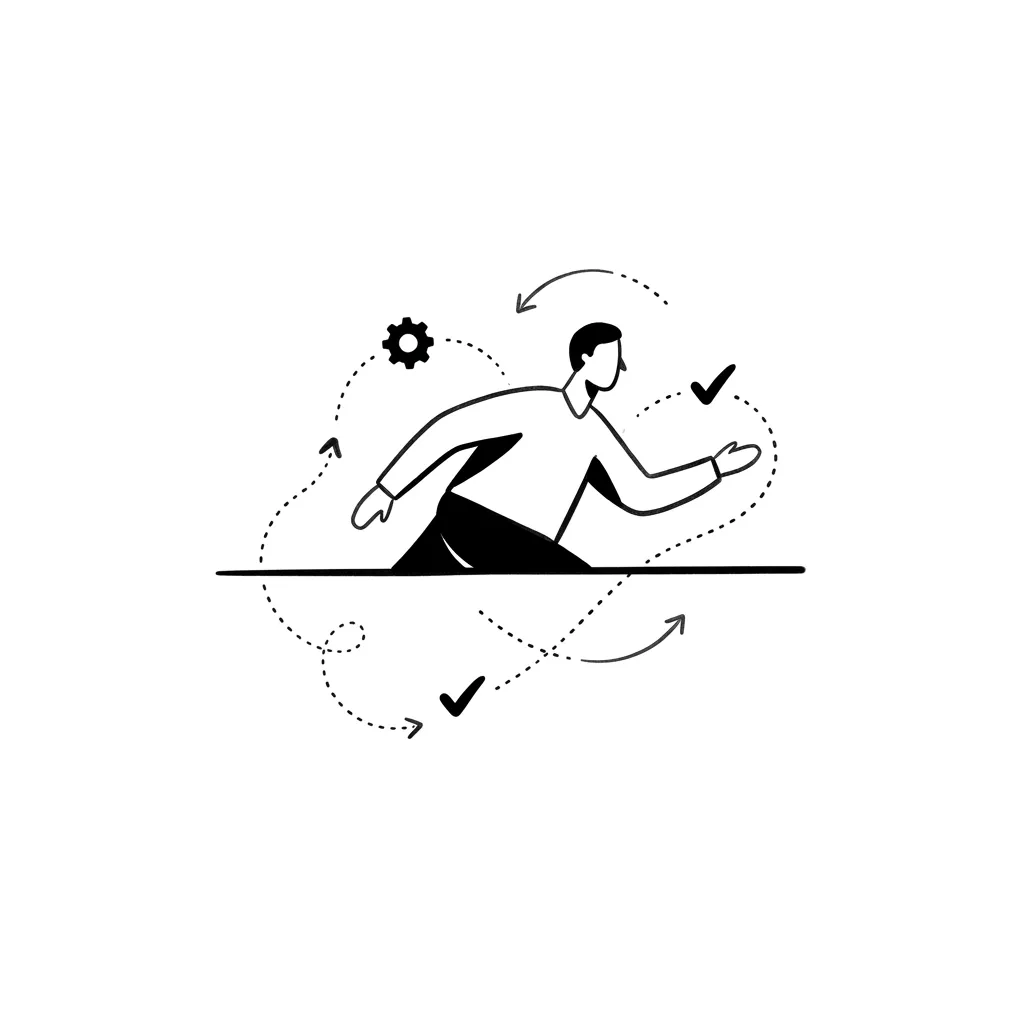
When you face a task and feel overwhelmed, anxious, or frozen, you are experiencing ADHD task paralysis. This is a neurobiological freeze triggered by low dopamine in the prefrontal cortex. This guide teaches you the “Two-Minute Glide”: forget the final outcome, commit to doing just two minutes of work, and give yourself full permission to stop. Trick your brain using physical momentum.
You are staring at a mountain of dirty dishes in the sink.
You have been staring at them for an hour. You know it will take only ten minutes to wash them. Yet, your body feels as if it has been poured into the chair with concrete. You can’t summon the energy to stand up. Your mind fills with guilt: “Why can’t I do this simple thing? I’m so lazy.”
This is Task Paralysis.
For the ADHD brain, initiating a task is like starting a rusty steam engine. When the brain anticipates a task that is large, boring, or complex, it registers it as a threat, cuts off the dopamine flow, and puts the body into a state of freeze.
To break this cycle, you shouldn’t rely on sheer willpower. Instead, you need to lower the friction of starting to nearly zero.
Enter the “Two-Minute Glide”.
The Mechanism: Stop Looking at the Finish Line
We freeze because our eyes are locked on the finish line.
If you need to write a report, you focus on “producing a perfect 1,000-word draft.” If you need to clean the room, you focus on “vacuuming, dusting, folding clothes, and sorting trash.” These grand goals place an immense cognitive load on your prefrontal cortex.
The secret of the Two-Minute Glide is: trick your brain into thinking there is no finish line.
Forget about finishing. Your goal is simply: “do anything for two minutes, and then you can stop.”
- Doing the dishes: Don’t think about the pile. Your goal is: “Turn on the tap, soap up one spoon, scrub for two minutes.”
- Writing a report: Don’t think about the content. Your goal is: “Create a blank document, type a messy working title, type for two minutes.”
- Reading a book: Don’t think about the chapter. Your goal is: “Open the book, read the first paragraph, read for two minutes.”
The Magic of Physics: Inertia and Momentum
This is where physics takes over.
Newton’s first law of motion states that an object in motion stays in motion. Once you start washing that spoon, you will likely wash the plate next to it. Once you write the title, you might jot down a couple of bullet points.
This is Momentum.
Starting is the hardest part. Once you cross the initial threshold, your brain receives a tiny dopamine boost, and the friction of the task drops by 80%. Even if you still feel miserable after two minutes, you have full permission to walk away. After all, washing one spoon is infinitely better than washing zero.
Knowing you can stop at any time provides a psychological safety net, making it much easier to start.
3 Practical Tools to Glide Easier
To make starting even lower-friction, try these physical setup tips:
- Lower your standards: Give yourself permission to produce garbage. When writing, dump your thoughts onto the screen without editing. When cleaning, wipe the most obvious spot. Remember: a terrible start is infinitely better than a perfect freeze.
- Keep starting triggers nearby: Leave the tools you need in plain sight. Keep your book open on your pillow; leave your yoga mat unrolled next to your desk.
- The “3-2-1 Glide” countdown: Count down out loud: “3, 2, 1, glide!” Treat your body like a machine and launch into action before your brain can search for excuses.
Survival Baseline: Be a “Spoon-Washer”
Some days, your battery is genuinely depleted.
If your energy is at zero and you still feel exhausted after two minutes, then washing just one spoon is your survival baseline. Let go of the guilt.
A clean spoon is a small, quiet, and genuine victory.
Quick Q&A
I tried this, but after two minutes I felt incredibly frustrated and wanted to quit. Is that normal?
Absolutely. It means your brain is running on empty today. Stop immediately, walk away, and congratulate yourself for successfully starting for two minutes. You didn't fail; you did two minutes of work, which is a success. Rest up and try again tomorrow.
If I stop after two minutes every time, won't I never finish anything?
This is perfectionism talking. In reality, once you start, there is a 70% chance you will keep going. Even if you do stop after two minutes, accumulated two-minute efforts will always yield more progress than sitting in paralysis for days. Two minutes is infinitely better than zero.
How do I prevent overthinking before my two-minute glide?
Move your body before your brain can catch up. Use physical triggers: don't think about the report, just command your finger to press the computer power button. The more mechanical and automatic the action, the lower the start friction.
Recommended Reading
Frozen on the Couch with a Looming Deadline? The Micro-Step SOS Guide for ADHD Task Paralysis
Looming deadlines leaving you frozen in your seat, scrolling for hours in guilt? Break out of ADHD task paralysis with these physical micro-steps.
How to Beat Task Paralysis: 6 Best ADHD Productivity Apps & Workflows
Struggling with ADHD task paralysis? Explore 6 top ADHD productivity apps (ADHDOS, Endel, Notion, Ash, Obsidian, Hermes Agent) and discover 4 low-friction workflows to boost executive function.
“Stop Parenting Me”: Healing the Parent-Child Dynamic in ADHD Relationships
Forgetting chores, missed promises, and zoning out... How do ADHD couples break free from the exhausting parent-child dynamic? Discover the executive dysfunction behind relationship friction and practical, friction-free systems to rebuild partnership.