 ADHD OS
Time Blindness Messing Up Your Day? Visualizing Time for Chronically Late ADHD Brains
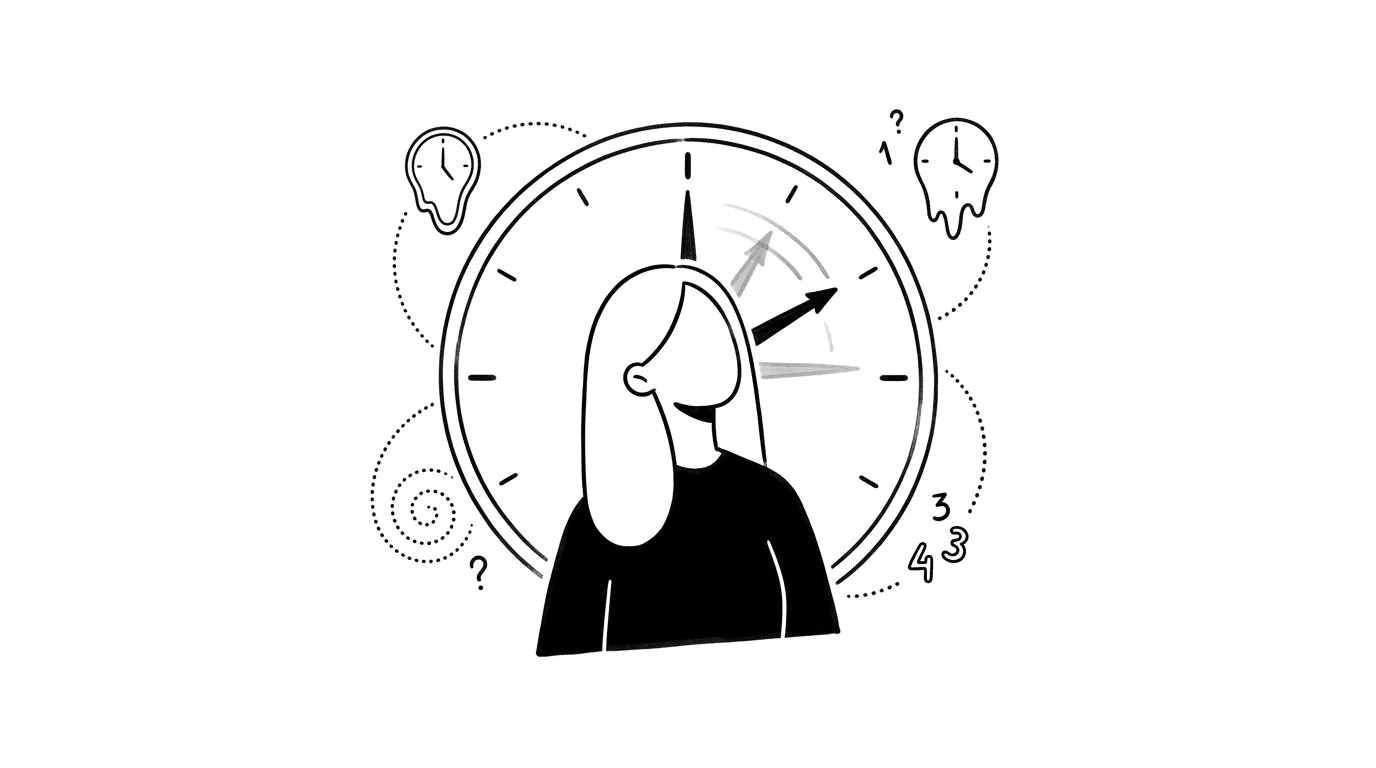
Have you ever sat frozen, unable to read or do chores, because you had an appointment at 3 PM and got sucked into a vortex of “waiting” all morning? Or assumed “I have only scrolled for 5 minutes” only to realize two hours have vanished? This is time blindness in ADHD. Our brains lack an internal clock. Here is how to construct external, visual time anchors.
You have an important meeting at 2 PM. It is currently 10 AM, meaning you have 4 full hours of free time. Yet, you sit frozen on the couch, unable to read, start a report, or cook lunch. You feel trapped in an invisible countdown cage. Your mind spins in neutral. This is waiting mode, a state of paralysis that plagues neuro-divergent individuals.
At the other extreme, you tell yourself, I will check my phone for 5 minutes before leaving. When you look up, 90 minutes have vanished, and you are 20 minutes late.
You oscillate between chronic lateness and waiting mode paralysis, facing constant criticism. But internally, this behavior is driven by time blindness.
The Neurobiology of Time Blindness: The Broken Mind Clock
According to Dr. Russell Barkley’s Executive Function Deficit Model, the ADHD brain exhibits a biological deficit in non-verbal time perception. Clinical data indicates that individuals with ADHD experience a 30% to 50% variance in duration estimation compared to neurotypical controls, and up to 77% of adults with ADHD report chronic, severe impairments in tracking time passage and managing lateness (Barkley, 1997).
Specifically, this neurological impairment manifests in three primary ways:
- Internal Pacemaker Deficit: Neurotypical brains possess an internal pacemaker coordinated by the basal ganglia and cerebellum. Neurons fire in rhythmic patterns, allowing the brain to measure the distance of “15 minutes” or “2 hours” without checking a watch. In ADHD, dopamine signaling in these pathways is reduced by approximately 35%, rendering the pacemaker unstable. We experience time in only two dimensions: “Now” and “Not Now”.
- Waiting Mode Anxiety: If a task at 2 PM is classified as “Not Now,” the prefrontal cortex struggles to calculate the distance between 10 AM and 2 PM. This ambiguity triggers alarm states. To avoid missing the appointment, the amygdala freezes your motor control, keeping you on high alert.
- Temporal Dissociation: When immersed in high-stimulation activities (hyperfocus), time disappears, blending into “Not Now.” You lose the ability to differentiate “5 minutes” from “50 minutes,” leading to chronic lateness.
You do not lack respect for others’ time; your brain lacks the neural sensory organ needed to perceive time.
3 Steps to Visualizing Time: Reconstructing Time Anchors
Since your internal clock is broken, abandon mental estimation. Use physical systems to make time visible.
1. The Focus Clock: Turn Numbers into Spatial Progress
Do not rely on digital number clocks (like 15:30). Numbers are abstract symbols to the ADHD brain and fail to trigger somatic urgency. Use the Focus Clock in ADHDOS. Choose the visual progress bar setting. Watching a red bar shrink like sand in an hourglass communicates time to your visual cortex, helping you disengage from hyperfocus.
2. Prep Buffers: Lock Prep Blocks in Your Calendar
Waiting mode is exhausting because your brain maintains high vigilance to prevent lateness. Open the Calendar in ADHDOS. Force-block a “preparation buffer” (e.g., 1 PM to 2 PM) before your appointment. Seeing this physical block allows you to tell yourself: Until 1 PM, my calendar is watching the schedule. I am safe to read or rest. This frees up prefrontal bandwidth, allowing elastic focus.
3. Multiply Estimates by the ADHD Coefficient (1.5x)
When you assume “getting ready takes 20 minutes,” you only calculate transit. You ignore the friction of finding keys, putting on shoes, or waiting for elevators. Forbid raw estimates. Multiply all estimated times by 1.5. A 20-minute trip becomes a 30-minute block on your calendar, absorbing attention drifts.
Quick Q&A
Why do digital clocks fail to alert me until it is too late?
Because digital numbers require a multi-stage translation (reading numbers, calculating distance, assessing threat) that a low-battery prefrontal cortex resists. Only when the deadline is physical does adrenaline spike to force action. Visual progress bars bypass this translation, triggering direct motor action.
How should I structure my hours during waiting mode?
Do not attempt high-friction tasks. The prefrontal cortex is occupied with vigilance. Use good-enoughism: schedule low-friction chores (like clearing inbox clutter, dusting, or organizing files). Do not start major projects. Do small things.
How do I explain my lateness to friends without sounding defensive?
Use the Double Empathy framework: 'Due to time blindness, my brain struggles to measure prep steps like finding keys. I am actively using visual calendars to manage this. I might occasionally have a 10-minute delay, but it doesn't mean I don't value our time.'
References & Citations
- Barkley, R. A. (1997). ADHD and the Nature of Self-Control. Guilford Press. PubMed Reference - Explores how non-verbal working memory impairments lead to severe time perception deficits in ADHD populations.
- Toplak, M. E., & Tannock, R. (2005). Time perception in children with attention-deficit/hyperactivity disorder (ADHD). Journal of Child Psychology and Psychiatry. PubMed Link - Experimentally demonstrates the 30%+ cognitive time-estimation deficit in ADHD.
- Rubia, K. et al. (2009). Deficits in timed motor execution and time perception in ADHD. American Journal of Psychiatry. AJP Journal Link - Correlates cerebellar and basal ganglia dopamine dysfunction with clinical time blindness.
Recommended Reading
Stuck in "Waiting Mode" All Day? How to Visualise Time and Escape the ADHD Waiting Trap
Why an upcoming meeting paralyzes your whole morning. Read the neurobiology of ADHD time blindness and learn how to break the waiting mode using visual tools.
Running Too Many Threads in Your Brain? Resolving ADHD Multitasking Paralysis
Brain spinning in multi-threaded overload while your body sits frozen doing nothing? Learn how to clear your prefrontal memory to break the freeze.
Struggling to Switch Tasks? How to Bridge ADHD Transition Deficits Smoothly
Stuck in your previous activity and unable to move to the next? Understand ADHD transition deficits and how to switch gears without friction.