 ADHD OS
Struggling to Switch Tasks? How to Bridge ADHD Transition Deficits Smoothly
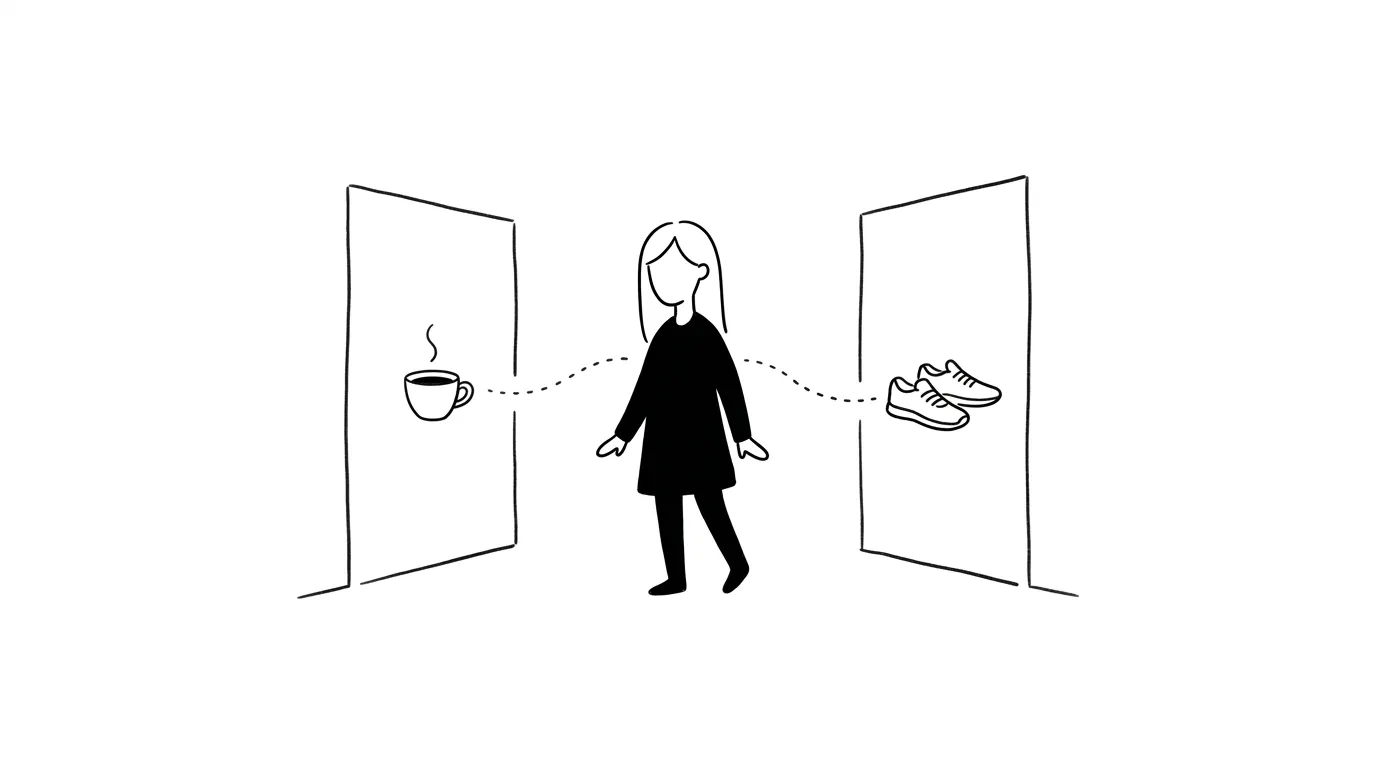
Have you ever had this frustrating moment: you decided to stop watching TV and start studying, but when the show ended, you sat frozen, unable to stand up? Or you felt intense anger when someone interrupted your work? This is called a transition deficit in ADHD. Switching tasks is neurologically jarring. You need a buffer ramp to shift gears. Here is how to build it.
You just finished the last round of your game or closed the video player. You know it is 8 PM, and you are fully aware that you must draft the presentation outline tonight. However, you feel physically chained to the couch. Your brain is shouting: Move! Get to your desk! But your body is heavy, and you find yourself mindlessly dragging your thumb across your phone screen. This constant pull between mental clarity and physical freeze drains your remaining executive energy.
In neurobiology, this is not a failure of character; it is a direct consequence of the ADHD transition deficit.
The Neurobiology of Task Switching: Why the Brain Fails to Shift Gears
In a neurotypical brain, changing activities involves a complex coordination of neural networks: first, the brain must suppress the Default Mode Network (DMN, responsible for daydreaming and self-reflection), activate the Salience Network to recognize the importance of the new task, and finally fire up the Task Positive Network (TPN, responsible for execution and focus).
In the ADHD brain, this gearbox is missing a clutch:
- Salience Network Dysfunction: The ADHD brain struggle to evaluate tasks on a linear scale. There is a massive “dopamine gap” between high-stimulation activities (like video games) and low-stimulation ones (like status updates or chores). Bridging this gap feels physically painful to our nervous system.
- Weak Prefrontal Inhibition: Getting our brain to disengage from hyperfocus requires a huge dose of executive energy. Without a gentle ramp, we remain stuck in the transition zone, caught in a state of paralysis.
To avoid the discomfort of a sudden shift, your brain defaults to stalling. Procrastination is your brain trying to avoid the friction of shifting gears.
3 Steps to Transition Tasks Friction-Free: Elastic Focus
Instead of expecting your brain to switch instantly, use the principles of elastic focus to construct a gentle psychological and physiological transition ramp.
1. Visual Desensitization: Use the Focus Clock
Do not rely on willpower or loud alarms. Sudden alarms spike cortisol and trigger threat avoidance. Open the Focus Clock in ADHDOS. It visualizes the passage of time on a clean progress bar. Place the clock in your peripheral vision. When your brain visually registers the time window for the current task closing, your Salience Network begins to adjust, reducing the brain’s attachment to the current activity.
2. Shift to Neutral with the Breath Orb
When you close your laptop or turn off the TV, do not force yourself to start work immediately. This causes neural gridlock. Give yourself 2 minutes to “idle in neutral”: close your eyes and open the Breath Orb. Breathe in sync with the visual, rhythmic expansion of the orb for 3 to 5 cycles. This is a critical somatic hack. Deep breathing stimulates the vagus nerve, calming the amygdala and shifting your nervous system into neutral so you can engage the next gear smoothly.
3. Warm Up with a Micro-Action
Once in neutral, perform a zero-resistance action:
- Instead of “working on slides for 2 hours,” say: “I will open my laptop and create a blank document.”
- Instead of “doing all the dishes,” say: “I will stand by the sink and turn on the warm water.” Once you clear the initial friction, momentum will naturally carry you into the task.
Quick Q&A
Why do I feel intense anger when my work is interrupted by someone?
Because rebuilding focus requires massive executive energy for ADHD. While focused, your brain constructs a fragile cognitive scaffolding. An interruption collapses this scaffolding instantly. Your anger is a defense mechanism against this sudden loss of cognitive energy.
How do I prevent task switching pain beforehand?
Use elastic focus. Allow the edges of your tasks to overlap. For instance, if you are transitioning from leisure to writing, keep your headphones on and listen to the same music as you sit at your desk. Write for 5 minutes before turning it off. Blurring the boundary is much easier than a sharp cut.
What if I get stuck switching from a low-energy task (like a meeting) to deep work?
Your prefrontal energy was drained by the meeting. Your brain lacks the fuel to start complex work. Do not push. Schedule a 5-minute break (e.g., walking to grab water, taking deep breaths). Let your physiological battery recharge slightly before starting the Focus Clock.
Recommended Reading
Time Blindness Messing Up Your Day? Visualizing Time for Chronically Late ADHD Brains
Cannot perceive how hours slip away? Or stuck in a painful "waiting mode" freeze before appointments? Discover hacks to tame ADHD time blindness.
Running Too Many Threads in Your Brain? Resolving ADHD Multitasking Paralysis
Brain spinning in multi-threaded overload while your body sits frozen doing nothing? Learn how to clear your prefrontal memory to break the freeze.
Screen Time Detox Failed Again? Why Forced Digital Blockers Backfire for ADHD Brains
Locking your phone in timed boxes or installing rigid blocker apps only to binge-scroll later? Understand why hard digital detox fails ADHD brains and how to build elastic focus.