 ADHD OS
Hobbies Everywhere, Mind Overloaded: Managing AuDHD Material Clutter and Sensory Noise
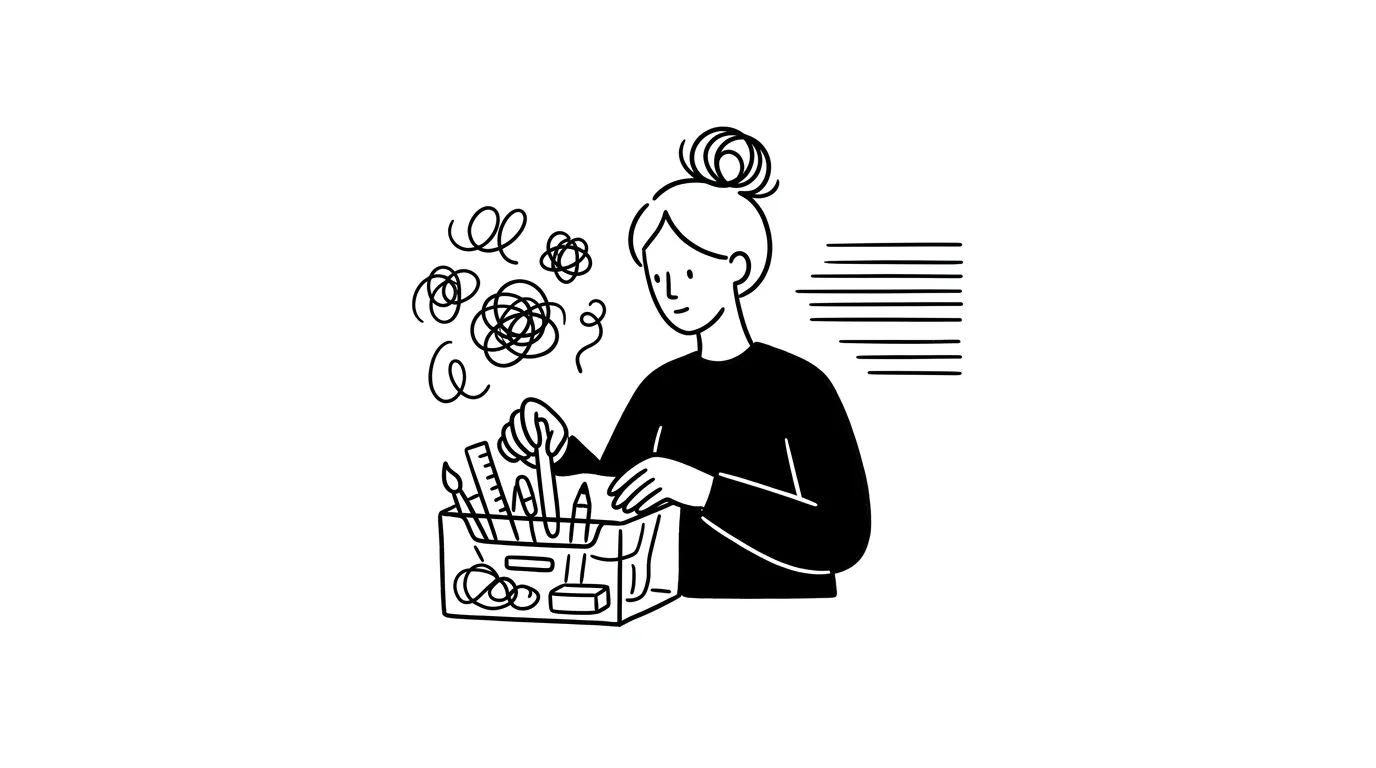
Do you live in a room cluttered with oil paints, camping gear, and half-built Legos due to your ADHD curiosity, yet find yourself suffocated and overwhelmed by this exact mess because of your Autistic sensitivity to physical disorder? This is the classic AuDHD spatial trap. This guide provides a low-friction “visual noise isolation protocol” to accommodate your rotating hobbies while preserving a sensory sanctuary for your brain.
For AuDHD individuals, tidying a room is never just a matter of “discipline”—it is an act of sensory defense.
- The ADHD Hoarding Impulse: ADHD brains struggle with “Object Permanence.” If a tool is out of sight, it physically ceases to exist in your working memory. To prevent forgetting, you leave paints, documents, and books cluttering your primary desk. And because you constantly open new interests, the pile grows indefinitely.
- The ASD Visual Suffocation: Autistic nervous systems are extremely sensitive to visual stimuli. Coffee mugs, charging cables, and brightly colored hobby boxes act as loud “Visual Noise (Visual Clutter)”. They compete for your limited prefrontal cortex attention, causing restlessness, anxiety, and eventual brain drain.
This forms a vicious cycle: ADHD drives you to create clutter, while ASD collapses because of it.
We do not need to force ourselves into extreme minimalism. We need a low-friction spatial firewall.
1. Physical Zoning: The Sandbox vs The Sanctuary
Do not attempt to keep your entire house spotless—that is self-sabotage for your ADHD side. Instead, segment your space:
- The ADHD Chaos Sandbox: Designate one specific zone (e.g., a large work table or a deep drawer). In this zone, tools can be left out, messy, and visible. Let your brain see everything it needs to see.
- The ASD Absolute Sanctuary: Your bedhead, or the wall directly in front of your desk, must be spotless and empty. When feeling sensory overload, turning your gaze to this minimalist sanctuary cools down your nervous system.
2. Dampening Visual Noise: Conceal and Label
Since leaving things out causes ASD overwhelm, and hiding things in dark boxes triggers ADHD forgetfulness, choose a compromise: labeled uniform containers.
- Uniform Tones to Dampen Noise: Use white or kraft-colored storage boxes to block chaotic packaging. This keeps the visual landscape clean for your ASD side.
- Massive Text Labels: Write bold, clear labels on the front of each box (e.g., 【ART PENS】, 【LEGO PIECES】, 【CABLES】) or attach a polaroid of the tools inside. You shield your eyes from visual clutter while preserving the ADHD map of where things live.
3. One-Step Storage: Ditch Complex Sorting
Most tidying guides tell you to categorize items into dozens of sub-categories. For AuDHD executive dysfunction, this is a nightmare. You do not have the dopamine to sort colored pencils by shade.
Keep the sorting barrier low:
- Wide-Mouth Bins: Keep open bins for each hobby. When drawing time is over, do not put pens away one by one. Throw everything all at once into the designated art bin, put the lid on, and call it a day.
- Stick to coarse categorization (one bucket per hobby) and skip fine sorting. Once items vanish from your sightline, visual noise isolation is accomplished.
Be gentle with your space. Let your hobbies have their landing pads, and let your nervous system have its peace.
Quick Q&A
I pile delivery boxes and takeout trash in my room, hating the sight but unable to move. How do I break this?
This is executive function paralysis. Use 'checkpoint interception': place a large trash bin right at your entryway. Force yourself to unbox deliveries and drop bags there immediately. Do not allow boxes or trash into your living room. Cut off the pollution source physically before it reaches your visual field.
I still forget what is in labeled boxes. How can I see my tools without generating noise?
If text labels fail, use transparent acrylic bins, but align them neatly against the wall. Autistic traits find peace in alignment and order; ADHD needs visibility. Neatly stacked transparent bins represent the perfect physical compromise between the two traits.
Recommended Reading
Sensory Overload Meets Clutter? A Low-Friction Organizing Guide for AuDHD Spaces
Do things disappear from your mind once tucked into drawers? Yet leaving them out causes visual overwhelm? Explore this low-friction organizing guide designed for AuDHD.
When the Brain Power Cuts Out: A Guide to Autistic Meltdown and Shutdown Recovery
Decoding the stress responses of autistic meltdowns and shutdowns. Learn the neurological triggers and implement low-friction SOS protocols for self-rescue and support.
The Autistic Sensory Shield: How to Navigate Overwhelming Environments Safely
Why supermarkets and transit exhaust your brain. Build a personal physical sensory shield with noise reduction, textures, and low-friction navigation strategies.