 ADHD OS
The Kaleidoscope Mind: How the Collision of ADHD and ASD Creates Unique Strengths
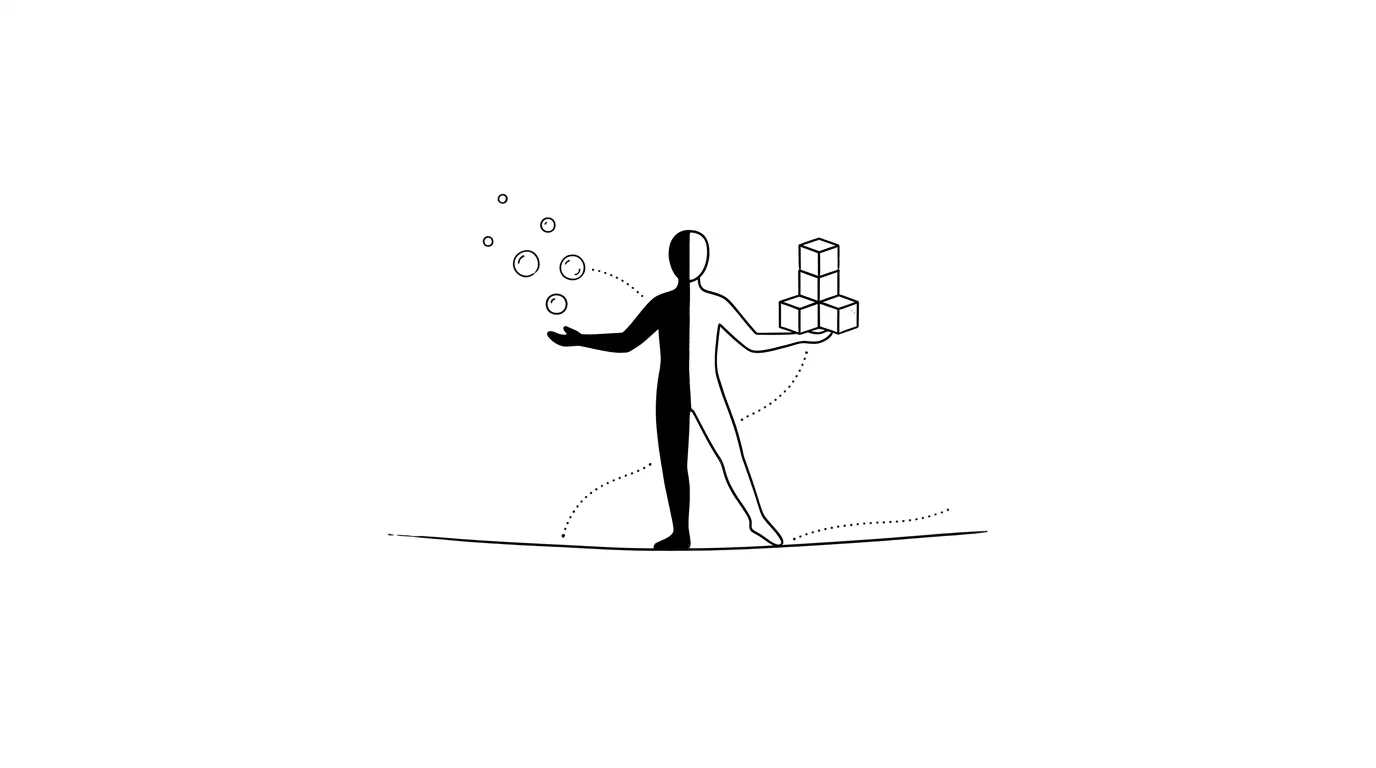
The ADHD and ASD in an AuDHD brain don’t just coexist—they collide to create something new. The Explore-Deepen dual loop, the Rule-Examiner-meets-Intuitive-Breaker problem-solving style, and intermittent high-octane hyperfocus are cognitive tools unique to AuDHD minds. This post unpacks how these strengths work and offers AI collaboration strategies to amplify them.
It’s 2 AM. You have 47 browser tabs open.
The first three are work-related technical docs. The fourth is a beetle taxonomy article you stumbled on half an hour ago. Tabs five through twelve are the chain reaction: from beetles to biomimicry to soft robotics to an open-source hardware project. Tab thirteen is a competitive analysis for an app idea that has nothing to do with any of the above.
You close the browser, feeling a mild self-loathing, and go to bed. Another night with nothing to show.
Three days later, in the shower, the beetle’s exoskeleton structure and the soft robot’s joint mechanism suddenly snap together in your head. A clear solution emerges from the chaos. You draw a rough sketch on the foggy glass, rush out, open your laptop, and barely sleep for the next 48 hours—building a complete prototype.
This isn’t a short attention span. This is how an AuDHD brain operates.
We get squeezed between two stories. One says: “You have two disorders, double the suffering.” The other says: “Every disorder has superpowers!” and pastes ADHD creativity next to Autistic focus like a motivational collage.
Both miss the point. AuDHD is not 1+1=2. It’s ice and fire colliding inside the same skull—producing steam, something entirely new.
The Explore-Deepen Dual Loop
Your brain has a built-in workflow that most people need an entire team to replicate.
ADHD runs the “Explore Phase.” It works like a radar, constantly scanning the environment for novel, interesting signals. You follow five or six completely unrelated fields—quantum computing, fermentation, urban planning, an obscure instrument. Others see scattered interests. Your brain is quietly building cross-domain indexes in the background.
ASD runs the “Deepen Phase.” When one of those cross-domain connections suddenly clicks—when the puzzle piece snaps into place—your pattern-recognition system fires. ASD’s systemizing engine takes over. You start building folder structures, drawing architecture diagrams, writing docs, prototyping. The shift from chaos to order is so absorbing you forget to eat.
It’s like being the product manager and the architect in one person. The product manager roams the world hunting for needs, inspirations, possibilities. The architect takes those scattershot possibilities and turns them into executable systems.
Most people are good at one of these. They either have a mountain of ideas that never ship, or they execute well but only along paths others have drawn. You have both.
The cost is real, too. Switching between phases can hurt. A long Explore phase makes your ASD anxious—nothing has landed. A long Deepen phase makes your ADHD suffocate—the world is happening outside while you’re locked in a room.
But once you recognize the dual loop exists, you can work with it instead of against it.
Unconventional Problem-Solving
In a meeting, has this ever happened to you? Everyone is methodically discussing how to optimize step three of the process. Meanwhile, you’re stuck on a different question: why can’t step three and step seven just be merged?
This instinct comes from AuDHD’s dual perspective.
Your ASD side makes you a “Rule Examiner.” You naturally deconstruct the underlying logic of systems and spot contradictions between rules. Others accept “the process is the process.” You ask, “Why is this the process? Does the original assumption still hold?”
Your ADHD side makes you an “Intuitive Breaker.” Once ASD finds the logical gap, ADHD’s divergent thinking supplies an unorthodox solution—not the straight line from A to B, but a bizarre shortcut from A to G to D and somehow landing at B.
This combination can be surprisingly powerful.
When coding, you might instantly see that a framework’s design philosophy fundamentally conflicts with the problem at hand, and an “off-label” tool is actually the better fit. When planning a project, you might wire two seemingly unrelated modules together and skip four intermediate steps.
To be fair, this ability is easily misread. In environments with rigid hierarchies and strict procedures, your “why can’t we merge these?” gets translated as “doesn’t respect the process” or “too impractical.”
But in startups, indie development, research, and creative industries—anywhere nonlinear thinking is rewarded—the “see through the rules + break the rules” combo is exactly the scarcest skill.
Intermittent High-Octane Hyperfocus
Let’s be honest about something: AuDHD energy output is unstable. Very unstable.
Some days, replying to a single text message takes half a day of internal negotiation. Other days, you produce output at a rate that startles even yourself—not grinding, effortful output, but creativity-and-detail-simultaneously-at-full-capacity output.
This burst happens during a specific moment: when ADHD’s excitement and ASD’s immersion both activate at the same time.
You discover a new project that thrills you (ADHD’s dopamine ignites). Simultaneously, the project’s complexity and structure hit your pattern-recognition sweet spot (ASD’s deep focus fires). Two fires burning together.
The result: you start Friday evening and by Sunday midnight you’ve built a complete prototype. Every module is thought through. Every interface is polished. The README is more detailed than most official projects. What takes others two weeks, you did in a weekend.
This state is hard to manufacture on demand. But you can learn to recognize its precursors—you notice yourself researching obsessively and getting more energized rather than more tired. When that happens, don’t suppress it with “reasonable time management.” Clear your schedule. Give it room to erupt.
The cost, again, is real.
After a burst, you might need two or three days of recovery. Lying in bed, mind blank, motivation absent. If you force productivity during recovery, you’ll trigger a more brutal crash.
Accept this rhythm. You’re not an engine designed for steady daily output. You’re a geyser. Build pressure, erupt, rest, repeat. The cycle itself is not the problem. The problem is measuring yourself against the “8 productive hours every day” standard.
AI Collaboration Strategies for AuDHD
AI tools are an excellent external module for the AuDHD brain, but they also hide a trap tailor-made for us. Let’s start with the good part.
Amplify the Explore-Deepen loop with AI
During the Explore phase, let AI handle the repetitive information gathering and initial filtering. You don’t need to read 20 paper abstracts yourself—let AI extract the key points while you do what ADHD does best: make intuitive leaps and cross-domain connections. “This connects to that thing I saw three months ago”—that kind of lightning association is something AI cannot replicate.
During the Deepen phase, use AI to organize the sparks scattered across sticky notes, phone memos, and chat logs into structured documents. ASD loves systematization, but the cognitive load of manually sorting everything can drain you before you even begin. Let AI build the skeleton. You fill in the flesh.
Use AI to mediate the inner conflict
Here’s the most elegant trick: when ADHD wants to jump to a new project while ASD wants to keep digging into the current one—open an AI tool and spend five minutes dictating the current project’s progress, sticking points, and next steps.
This gives ADHD a “safe exit”: you haven’t abandoned the project; you’ve archived it, and you can come back anytime. It also gives ASD an “orderly handoff”: everything is recorded; nothing will be lost.
Watch out for “toolchain paralysis”
Now the trap.
ADHD’s curiosity about new tools plus ASD’s compulsion to optimize workflows—this combination can lead you to spend massive amounts of time building “the perfect AI workflow” while never starting the actual work.
You spend three days researching which AI writing tool is best. Two days building an automation pipeline. One day tweaking prompt templates. A week gone. Your output: zero.
The signal is easy to spot: if the time you spend “setting up AI processes” exceeds the time you spend “producing results with AI,” stop immediately. Use the simplest approach possible. Open a chat window. Start talking. Optimize later.
One more thing to remember: AI cannot replace your “ice-and-fire collision.” Your most brilliant ideas—the ones born when beetle exoskeletons and soft robotics merge in your brain mid-shower—come from the friction between ADHD and ASD inside your head. No AI possesses that kind of internal tension.
AI is the amplifier. You are the signal.
Quick Q&A
My ADHD wants to jump to a new project, but my ASD won't let go of the current deep-dive. How do I reconcile them?
Use the 'Five-Minute Archive' method. Open whatever tool is handy—notes app, voice memo, AI chat—and spend five minutes dumping the current project's status: progress, blockers, next steps. This satisfies both sides. ADHD gets permission to leave; ASD gets the reassurance that nothing will be lost. When the novelty of the new project fades, you can reopen the archive and pick up exactly where you left off.
I feel guilty during the recovery period after a burst of intense output. How do I accept it?
Change your unit of measurement. Instead of evaluating productivity by the day, zoom out to the week or month. The work you produced during a two-day burst might equal someone else's entire week. Recovery isn't laziness—it's your brain consolidating and integrating high-density information. If you force output during recovery, you'll only extend the crash cycle. Letting yourself rest is part of the system working as designed.
I keep spending days building the perfect workflow instead of starting actual work. How do I break this loop?
Set a hard rule: any new tool or workflow gets a maximum of 30 minutes of setup time, after which you must produce a minimum viable output. Even if it's rough. Your ASD will protest—'It's not good enough, the setup isn't optimized'—but producing first and optimizing later always beats perfecting first and starting never. The perfect workflow doesn't exist. The workflow that lets you start working is the best workflow.
Recommended Reading
Beyond the Deficit: 3 Cognitive Superpowers of the ADHD Brain
ADHD is more than distraction and procrastination. Crisis-mode clarity, cross-domain associative thinking, and interest-driven hyperfocus are real cognitive advantages backed by neuroscience. Learn how to leverage them—and how AI tools can amplify these strengths without becoming a new trap.
The Power of the Monotropic Mind: ASD Strengths in Systemizing and Detail
Your attention is not "too narrow" — it is a precision instrument. Monotropic focus, pattern recognition, and radical honesty are autistic strengths that shine in the right context. Learn how to amplify them with AI while avoiding common pitfalls.
How to Set Boundaries with ADHD & ASD: 5 Science-Backed Ways to Say No
Stuck in people-pleasing and burnout? Learn how to establish healthy boundaries with ADHD and ASD using a CBT-based "communicate + act" method across work, family, and tech.