 ADHD OS
The Power of the Monotropic Mind: ASD Strengths in Systemizing and Detail
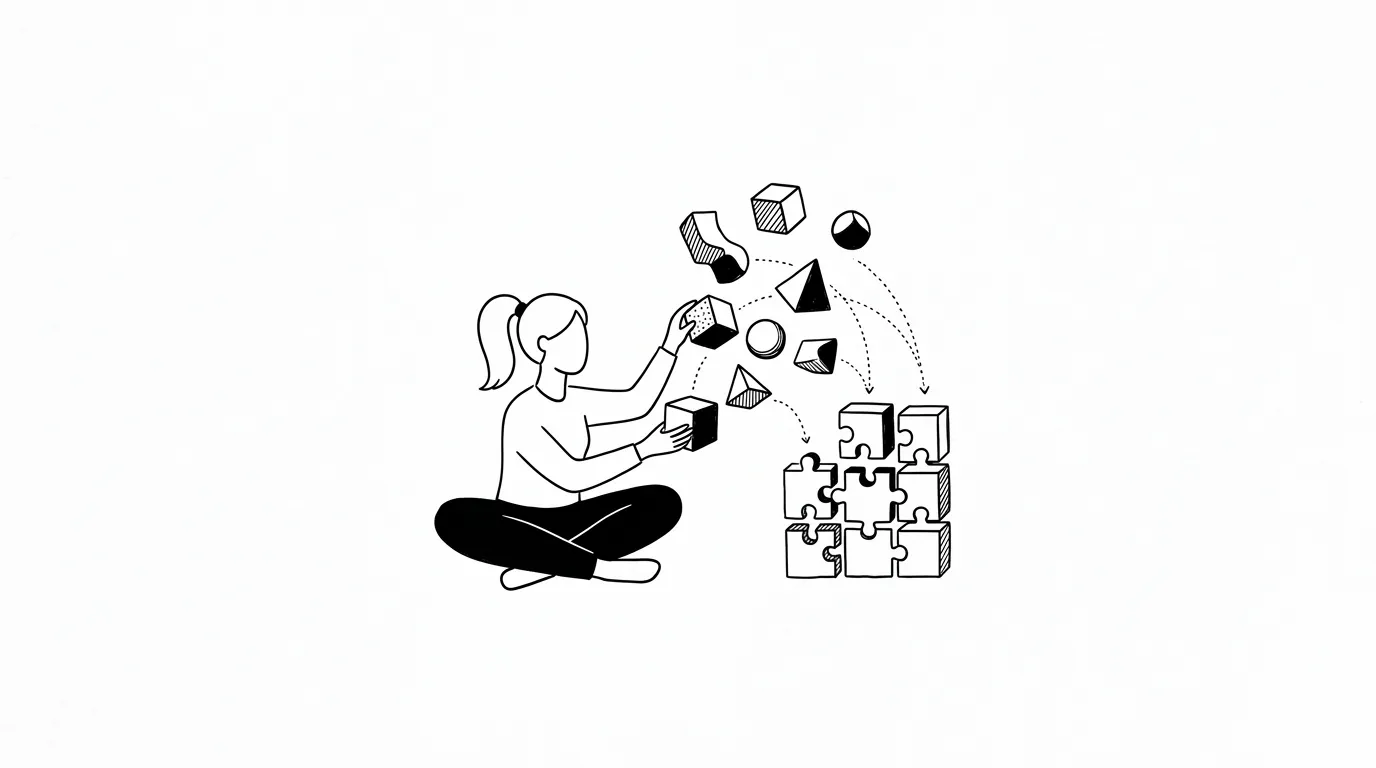
Monotropic focus, systemizing ability, and radical honesty are not side effects of ASD — they are standalone cognitive strengths. This article breaks down these undervalued traits with real scenarios and explores how AI tools can amplify them without creating new problems.
Here is a scene you might recognize.
Saturday afternoon. The group chat lights up with dinner plans. You glance at it, lock your phone, and set it face-down on the desk. You have been digging into a technical problem for six hours straight — one paper led to twelve, and your brain has assembled an intricate scaffolding of concepts that feels as precise as clockwork. Going to a noisy hotpot restaurant right now would shatter that scaffolding. You would never reassemble it exactly the same way.
You stay home.
Then comes the text: “You never come out. Are you okay?”
You are fine. Explaining that, though, is exhausting. Because the other person does not understand that you are not “isolating.” You are doing something you are exceptionally good at — going deep.
This article is for anyone who has been called “too quiet,” “too intense,” or “too obsessive.” Let’s look at what those traits actually are when you stop viewing them through the lens of social norms.
1. Monotropic focus: your attention is not narrow — it is a tunnel
There is a term in psychology called monotropism. It describes a cognitive style in which attentional resources concentrate heavily on a single channel. Most people’s attention works like a sprinkler — it waters many patches of ground simultaneously. The autistic mind works more like a fire hose. One direction, massive pressure.
What does that look like in practice?
You hit a bug on a Saturday morning. You open the docs, follow a thread into the source code, jump to the related RFC, land on a 2019 research paper. By 8 PM your water glass is still full (untouched), but your understanding of that micro-domain surpasses most of your team.
Or you pick up a strategy game. While others enjoy the storyline, you are deconstructing damage formulas. Crit thresholds, equipment affix synergies, hidden scaling ratios — you map them all out in a spreadsheet.
From the outside, this looks like obsession.
Drop the same behavior into academic research, security auditing, or data engineering, and it has a different name: deep domain expertise. A weekend plus an uninterrupted tunnel is all it takes to go from zero to near-expert in a narrow field.
This is not stubbornness. It is an architectural difference in information processing. Others run many light tasks on a multi-threaded processor. You run one heavy task on a single-threaded processor — deeper, more thorough. Neither mode is better. They fit different situations.
2. Systemizing: the patterns you see are genuinely invisible to others
Baron-Cohen proposed a cognitive framework in which thinking styles fall along two axes: systemizing and empathizing. Autistic brains tend to score high on the systemizing end — naturally sensitive to data, structure, and logical rules.
In daily life, this shows up constantly.
You are reviewing a contract. Everyone else signs off — “looks standard.” You pause at clause seven: “The liability cap here contradicts the indemnity clause in section three.” You were not looking for trouble. You simply could not not see it.
A teammate shows you quarterly sales data. They are building a monthly summary. You are staring at a strange dip in one region during week three. You are not sure what it means yet, but your brain has already flagged it and is running hypotheses in the background.
When organizing notes, you instinctively build classification systems. Not a simple folder hierarchy — a tagged, cross-referenced structure with internal logic. You think this is normal until a coworker looks at your notes and says: “Are you building Wikipedia?”
One clarification matters here. Scoring high on systemizing does not mean you are cold or emotionless. It is a cognitive preference, not a personality verdict. You may care deeply about people — your way of showing it is helping them sort out their problems logically and listing their options, rather than sitting beside them and crying together.
Both ways of caring are valid. One is not lesser.
3. Radical honesty: you are stating facts, not launching attacks
This one comes with a painful admission first.
Many autistic adults spend years masking. You have trained yourself to run a “social filter” before every sentence: Is this too blunt? Should I add some softening first? When they said “it’s fine,” did they mean it is fine, or is it code for something else?
That constant cognitive translation is draining. Over time, it can trigger autistic burnout — not because the work is hard, but because performing normalcy is hard.
The flip side of masking, though, is a rare quality: you say what you mean, and there is almost nothing hidden between the lines.
In a meeting, everyone dances around the fact that the current proposal has a flaw. Nobody wants to be the first to say it. You say it. Not because you want conflict, but because the mental subroutine for “compliment first, then gently hint at the issue” simply is not pre-installed in your operating system. You see the problem. You name it. That is all.
In workplaces that value transparency, this directness is a trust asset. Your colleagues may need time to adjust, but eventually they realize: “When you say it works, it actually works. When you say there is a problem, there is actually a problem.” No guessing. No decoding.
You are not “bad at reading the room.” You have the ability to resist social pressure and state facts when everyone else is performing political correctness. Put that ability in quality assurance, security assessment, or code review, and its value speaks for itself.
This does not mean zero adjustment is needed. Some contexts do call for packaging. But “being able to package” and “not naturally beating around the bush” are two different things. You can learn the first one. The second is built into your OS.
4. AI and ASD: amplify your strengths, but do not let AI replace you
AI tools fit the autistic cognitive style in a few specific ways.
Use AI as a social translator. You wrote an email — accurate, logical, thorough. But you know the “direct version” might make the recipient uncomfortable. Hand it to an AI model and ask for a “workplace-friendly rewrite.” The meaning stays intact, the wording softens. You save the masking energy, and the other person gets a well-worded email. Both sides win.
Use AI to validate your intuitions. You spotted an anomalous pattern in a system and formed a hypothesis, but manually running every edge case takes too long. Describe the hypothesis to an AI and have it batch-test scenarios. Your pattern recognition handles discovery; AI handles verification. Clean division of labor.
Use AI to structure your deep knowledge. You already know a domain inside out, but the knowledge lives in fragments across your memory — non-linear, hard to export. AI can help you organize those fragments into docs, tutorials, or a knowledge base. You dictate or outline; AI formats and fills in.
A few cautions, though.
AI output is probabilistic. It does not guarantee correctness or precision. For a brain that prefers certainty and accuracy, AI’s “close enough” can be genuinely irritating. Seeing an obvious factual error delivered with full confidence can trigger a cognitive clash that hits harder than it would for most people. Set your expectation going in: AI is a fast but unreliable drafting machine, not a precise finishing machine. You do the quality control.
Using AI to adjust your email tone is fine. Letting it fully replace real social practice is not. AI can translate social signals for you, but genuine connection requires your own presence. If every message goes through an AI polish before you send it, you risk drifting further from authentic interaction over time. Think of AI as training wheels, not a replacement for the bicycle.
One more thing. AI often returns vague or hedging answers when handling ambiguous intent or subjective emotional tasks. That kind of uncertainty can be uniquely uncomfortable for autistic users. If you find yourself getting anxious over the quality of AI output, that is the signal to close it and return to your own reasoning. Your judgment is the one that counts.
Quick Q&A
People keep calling my deep interests 'useless.' How do I turn them into real strengths?
Do not start by proving usefulness. Find where your deep interest overlaps with an actual need. Your obsessive knowledge of game mechanics, for example, maps directly to data analysis or systems modeling. Use AI to organize your accumulated knowledge into visible artifacts — documents, tutorials, or a structured knowledge base. A strength does not need universal recognition. It needs the right context.
I use AI to rewrite my emails, but the result never sounds like me. How do I fix that?
Add a constraint to your prompt: 'Keep my core meaning and vocabulary. Only adjust parts that might cause misunderstanding.' Ask for two or three versions so you can pick the one closest to your natural voice. The goal is micro-adjustment on top of your own expression, not a personality transplant. If the rewrite feels completely foreign, it failed.
I am good at finding system flaws, but colleagues say I am 'too nitpicky.' How do I balance that?
Lead with impact before detail. After finding a problem, start with one sentence about what it affects and how severe it is. Then present your analysis. This way the listener understands why they should care before hearing what you found. You can also use AI to convert technical findings into non-technical briefing formats. Your detection ability is real. It just needs a translation layer so more people can hear it.
Recommended Reading
The Kaleidoscope Mind: How the Collision of ADHD and ASD Creates Unique Strengths
AuDHD is not ADHD plus Autism. It is a unique cognitive chemistry. This post breaks down the Explore-Deepen dual loop, unconventional problem-solving, and intermittent hyperfocus—three strengths exclusive to the AuDHD brain—and offers AI collaboration strategies to amplify them.
Beyond the Deficit: 3 Cognitive Superpowers of the ADHD Brain
ADHD is more than distraction and procrastination. Crisis-mode clarity, cross-domain associative thinking, and interest-driven hyperfocus are real cognitive advantages backed by neuroscience. Learn how to leverage them—and how AI tools can amplify these strengths without becoming a new trap.
Struggling with Unwritten Social Rules? Painless Workplace Communication Guide for ASD Adults
Struggling to decode coworkers double meanings or spending hours drafting basic status updates? Reclaim your energy with structured templates.