 ADHD OS
Why "Good Girls" Burn Out: Decoding the Cost of Female Neurodivergent Masking
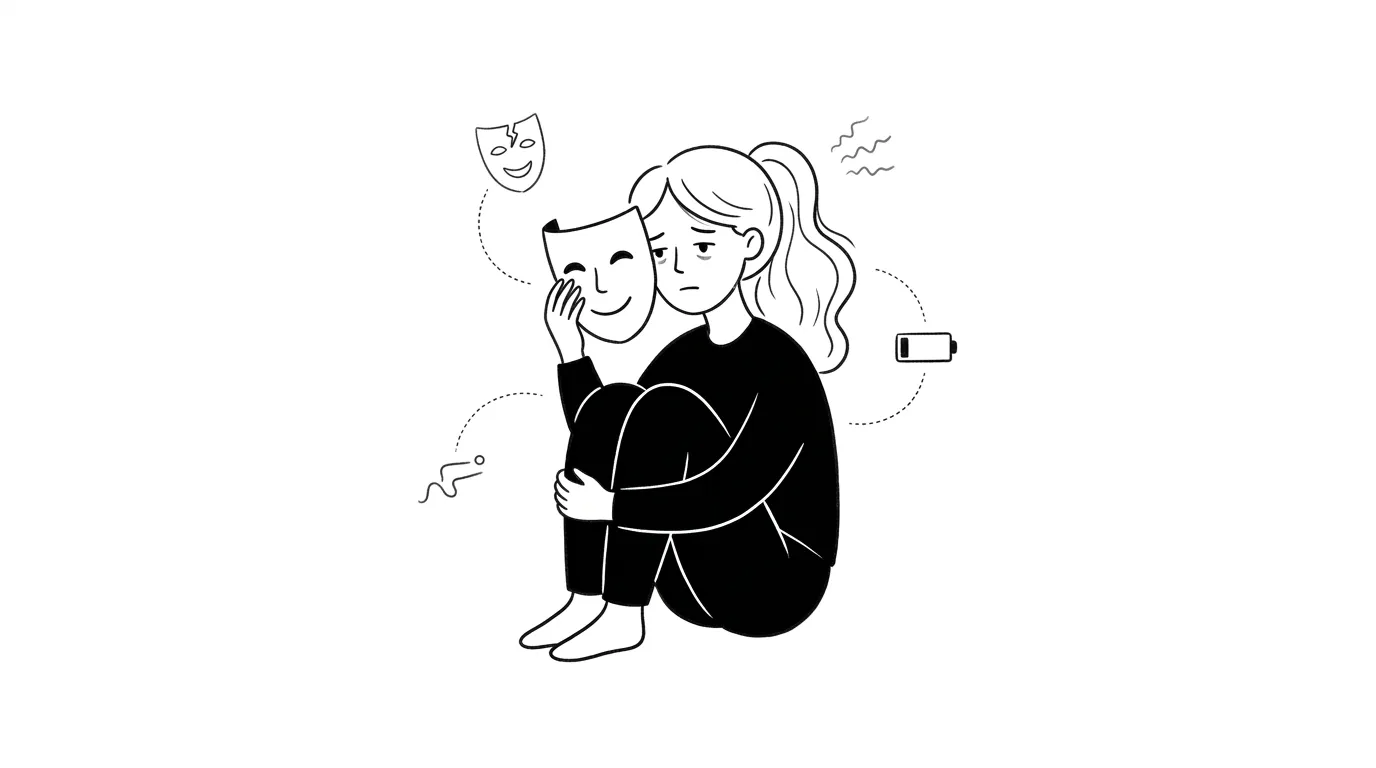
Do you find yourself smiling perfectly and keeping up effortless conversations in meetings or gatherings, only to collapse on the floor the moment you step through your front door? This profound exhaustion is not laziness; it is the steep tax of social masking. For neurodivergent women, conforming to the social ideal of the “good girl” keeps the prefrontal cortex in a state of chronic overload. This article decodes the biological toll of masking and offers a gentle guide to safe unmasking.
On the outside, we seem to have it all together.
In meetings, you make perfect eye contact, nod enthusiastically, and run a quiet algorithm in your head to calculate the exact millisecond to speak. At parties, you laugh at the right jokes, ask polite questions, and glide through the room as someone who is warm, social, and perfectly adjusted.
But the moment the front door clicks shut, the mask drops.
You drop your bag, slide down the wall, and sit in the dark hallway for an hour. Or you spend the weekend face-down on the couch, staring at a screen, unable to muster the strength to reply to a single text. Your brain feels hollow, and every sense screams for quiet.
In neurodivergent spaces, this state is known as autistic burnout. It is not ordinary fatigue; it is a physiological collapse caused by the long-term, high-stakes demand of social masking.
The Cost of Masking: Chronic Cognitive Overload
For neurodivergent women, navigating a social world is rarely an automated process. Instead, it is a complex, manually programmed task.
To appear “normal” and fit in, the prefrontal cortex runs heavy background processes every single second:
- Behavioral Suppression: Resisting the urge to fidget, stim, look away, or adjust your posture.
- Dialogue Scripting: Pre-planning conversations, predicting reactions, and analyzing double meanings.
- Sensory Tolerancing: Forcing yourself to ignore harsh fluorescent lights, background chatter, or itchy clothing tags, pretending nothing is wrong.
This manual compensation drains your cognitive battery. We act like a laptop running dozens of high-resource applications in the background. The screen looks bright and the system seems fast, but the processor is burning hot, and the battery is draining at triple speed. When your dopamine and norepinephrine reserves are tapped out, system shutdown becomes your body’s only survival mechanism.
The “Good Girl” Condition: Why Accomplished Women Go Undiagnosed
Many neurodivergent women are diagnosed late in life, often in their late twenties or thirties. Throughout childhood and adolescence, they are usually labeled as “bright,” “responsible,” or “highly empathetic.”
This stems directly from gendered social expectations.
From a young age, girls are conditioned to be cooperative, socially observant, and quiet. When a neurodivergent girl experiences sensory overload or social confusion, she rarely acts out or displays disruptive behaviors (which are more common in boys and draw faster clinical attention). Instead, she internalizes her distress.
Using high intelligence, she observes, dissects, and mirrors her peers. She reads magazines, studies the smiles of popular TV characters, and approaches socializing like a math problem to solve.
This high-masking ability makes her a “perfect student” and a “good daughter.” But the more successful the mask, the deeper her struggle is hidden. It is only when she transitions into adulthood—facing the compounding demands of career, relationships, and daily life—that the manual compensation system collapses.
Safe Unmasking: Practical Decompression Strategies
While masking is a survival tool that protects us in certain environments, using it constantly is toxic to your health. You need strategies to safely unmask and reclaim your boundaries.
1. Create a “Zero-Expression” Sanctuary
Do not try to drop your mask everywhere overnight. Start with a tiny, safe window: 30 minutes a day in a private space. Draw the curtains, turn off the lights, and let go of all physical control. Sit in silence, stim, make weird faces, or lay flat on the floor. Let your body exist without evaluation.
2. Broadcast Your Battery Level
Communicate your energy levels to those close to you using low-friction language. You do not need to explain or justify. A simple, pre-arranged phrase works: “My battery is at zero. I need to go to my quiet space to recharge. It is not about you.”
3. Implement Sensory Decompression
Social exhaustion is often triggered by sensory overload. Protect your nervous system by wearing noise-canceling headphones or earplugs when commuting. If your brain feels hot during a social event, take a two-minute bathroom break, splash cold water on your face, and close your eyes. These small physical interventions help interrupt the sensory input before a full shutdown.
Allow yourself to be awkward. Allow yourself to pause and withdraw. Unmasking is not about losing your protection; it is about reclaiming the energy that belongs to you.
Quick Q&A
If I unmask and act withdrawn, won't people think I am being cold or impolite?
Unmasking is not about offending others; it is about protecting your nervous system from collapse. With close friends or family, clear communication about your limits helps them understand you are not withdrawing out of anger. In professional settings, you can use polite boundaries—like wearing headphones or stating you need to focus on a deadline—to step away without guilt.
I have masked my entire life. How do I even distinguish my real self from the mask?
It is a slow discovery. Notice how you feel after different interactions. If a behavior (like laughing at an unfunny joke or talking just to fill silence) leaves you feeling hollow and physically depleted, it is likely part of the mask. The things that bring you calm and small moments of joy when you are completely alone—like staring at a wall, playing with a specific fidget, or deep-diving into a niche interest—are clues to your authentic self.
Recommended Reading
Monotropic Charging: Using Your Special Interests to Recover from Autistic Burnout
Special interests are powerful neurodivergent refueling stations. Discover how to intentionally dive into your passions to recover energy without neglecting basic physical needs.
Exhausted and Hollow? How to Identify AuDHD Burnout and Unmask Safely
Do you feel completely drained after socializing, with no energy left to speak? Discover how to tell AuDHD burnout from task paralysis and learn to build a safe unmasking space.
Waking Up in a Fog? How to Gently Boot Up Your ADHD Brain in the Morning
Stuck in heavy brain fog for hours after waking up, struggling to even get dressed? Learn how to align with your energy to boot up gently.