 ADHD OS
Goodbye "Should", Hello "Can": A Survival Guide for ADHD
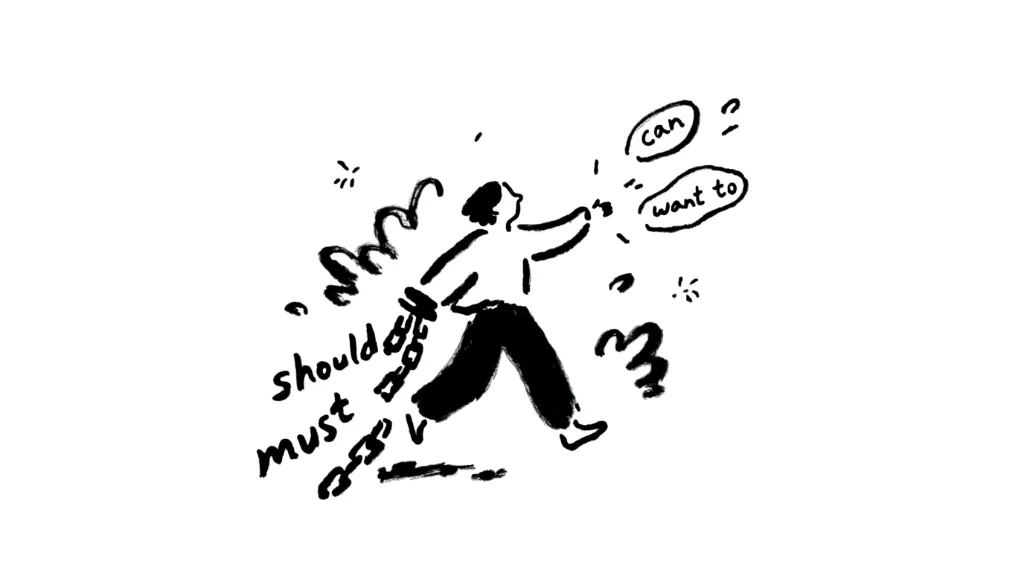
Let go of perfectionism and the constant self-criticism of “I should.” Use the Good-Enough Rule to slack off on daily chores, saving your precious brainpower for what really matters. Swap “I should” for “I can,” accept a little chaos, and work with your brain instead of fighting it.
The cardboard boxes from your online shopping have been sitting by the front door for three days. Every time you walk past, it bugs you. A voice in your head keeps nagging: “I should open them, flatten the cardboard, and put it in the recycling bin.”
The cold coffee cup on your desk is the same. You stare at it and think: “I should go wash it.”
Even in your chat list, there are a few messages from yesterday waiting for a reply: “I should text them back, they are waiting.”
The result? You do absolutely nothing. You are stuck on the couch, scrolling mindlessly on your phone for hours. You end up exhausted, drowning in guilt, and calling yourself “lazy and undisciplined.”
If you have ADHD, this is probably a daily loop. Our brains have a special knack for blowing tiny tasks into mountain-sized obstacles. And perfectionism is the supervisor whipping us from behind.
It’s exhausting. We need a different way to live.
There aren’t that many rules in this world. As someone once wrote:
Live however you “can”. There is no single, clear rule dictating how one must live, nor is there a single, proper lifestyle.
Why Are We Always Chased by “Should”?
For ADHDers, “I should” is a slow poison.
Traditional productivity tools tell us: “Write a to-do list and execute it one by one.” But they don’t know that the ADHD brain’s executive function is naturally short on dopamine. Starting a task takes ten times more activation energy for us than it does for others.
Then, perfectionism runs in to throw fuel on the fire.
Perfectionism in ADHD is rarely about “chasing excellence.” It is a defense mechanism. Having messed up so many times growing up, we are terrified of being judged or labeled “unreliable.” So, our brain defaults to an extreme All-or-Nothing mindset:
- Either I don’t do it at all, or I must do it perfectly.
- Either the desk is spotless, or it’s a disaster area.
- Drafting an email takes days because every sentence must be flawless and polite, otherwise it stays in the drafts.
Every time you say “I should do this,” the subtext is: “If I don’t, I am a failure.” This shame and pressure trigger our brain’s fight-or-flight response. Under stress, the brain simply shuts down—entering the state known as “ADHD paralysis.”
The Good-Enough Rule: Letting Go of the 100-Mark Illusion
Ray Bennett writes in The Sub-Standard Manifesto: “Forget about chasing success; mediocrity is the key to happiness.”
It’s not about giving up entirely, but about stopping the waste of brain energy on things that don’t matter. His principles fit ADHD perfectly:
1. Life is short Our energy is limited. For ADHD, focus is a rare, expensive currency. If we spend it all wrestling with cardboard boxes or unfolded socks, what’s left for our passions and strengths?
2. Control is an illusion We try to plan every detail to avoid mistakes. But life is chaotic, and ADHD life is a series of interruptions. Accept the slip-ups; it saves you from useless self-blame.
3. The law of diminishing returns A neurotypical person might spend two hours scrubbing the kitchen. For us, wiping the counter takes 10 minutes (good enough). Making it spotless takes two more hours. Those two hours bring very little value, but cost us a brain fry for the rest of the day. It’s a bad deal.
4. Perfection is the enemy of the good G.K. Chesterton once wrote, “If a thing is worth doing, it is worth doing badly.”
- Clothes unfolded? Keep them in the basket and wear them directly. Good enough.
- Too tired to cook? Have a frozen meal to keep yourself fed. Good enough.
- No energy for a shower? Wipe your face with a damp towel. Good enough.
Doing a mediocre job is always better than planning a perfect version in your head while doing absolutely nothing.
The Lazy Genius: Saving Energy for What Matters
Kendra Adachi’s book The Lazy Genius Way offers a practical compass: “Be a genius about the things that matter and lazy about the things that don’t.”
Our brain is like an old phone with terrible battery life. You wake up with 50% charge, or maybe 20% on a rainy day.
You cannot fight on all fronts. You must decide where to be lazy.
Make a list of your zones:
- My Lazy Zone: Fold laundry, organize the closet, do the dishes. In these areas, aim for “passable” or just wing it. If you don’t fold clothes, just grab them from the basket.
- My Genius Zone: Core work, hobbies, people you love. This is where you invest your hyper-focus when you have the energy.
Accepting the mess in your Lazy Zone means saying: “This doesn’t matter right now. I refuse to feel guilty about it.”
Three Practical Cards to Use Right Now
To put these ideas into action, try changing your daily habits:
First Step: Break tasks into tiny pebbles If you think “I should work,” your brain freezes. Make the starting step ridiculously small:
- Not “write the report,” but “open the laptop and create a document with a title.”
- Not “clean the kitchen,” but “wash this one spoon.”
Once the starting barrier is broken, dopamine drops in, and you might wash the rest. If not, hey, you still washed a spoon. That’s a win.
Second Step: Rewrite the script Replace “I should…” with “I can…”:
“I should go to the gym.”→ “I can put on my shoes and walk outside for five minutes. I’ll come back if I’m tired.”“I should reply to that email.”→ “I can send a quick ‘Received, will follow up later’ to park the task.”“I should focus better.”→ “I can take a ten-minute break and try again.”
“Should” is a whip; “Can” is an invitation. The brain resists invitations much less.
Third Step: Set boundaries to save battery Don’t commit to things beyond your charge. If someone asks for help and you are struggling, say no. Protecting your focus doesn’t make you a bad person.
Embrace the Chaos
An ADHD life won’t be a tidy notebook. You will have productive bursts and low-energy crashes. Your desk will get messy again.
That’s fine.
Embracing neurodiversity means accepting that you run on a different operating system. It might suck at filing folders, but it holds creative bursts others can’t match.
Stop fitting into the “should” mold. Put down the whip, be a happy “good-enoughist.” Today, you can do a little, or you can do nothing. Both are perfectly fine.
Quick Q&A
What is the difference between ADHD perfectionism and OCD?
ADHD perfectionism stems from executive dysfunction defense (fear of failure leads to task avoidance); OCD involves high anxiety and compulsive, ritualistic behaviors.
If I keep lowering my standards, won't I just become lazy and fail?
No. It's about selective laziness. Being lazy about laundry lets you save energy to be great at your core work or hobbies. It's energy management, not quitting.
What if I break tasks down but still can't start the first step?
Your battery is likely at 0%. Forcing it only increases anxiety. Accept the crash and rest without guilt. True rest is how you recover dopamine.
Recommended Reading
Beyond the Deficit: 3 Cognitive Superpowers of the ADHD Brain
ADHD is more than distraction and procrastination. Crisis-mode clarity, cross-domain associative thinking, and interest-driven hyperfocus are real cognitive advantages backed by neuroscience. Learn how to leverage them—and how AI tools can amplify these strengths without becoming a new trap.
The Kaleidoscope Mind: How the Collision of ADHD and ASD Creates Unique Strengths
AuDHD is not ADHD plus Autism. It is a unique cognitive chemistry. This post breaks down the Explore-Deepen dual loop, unconventional problem-solving, and intermittent hyperfocus—three strengths exclusive to the AuDHD brain—and offers AI collaboration strategies to amplify them.
Paralyzed by Perfection? How "Good-Enoughism" Beats Procrastination for ADHD Brains
Staring at a blank document because your expectations are too high? Learn how good-enoughism releases your prefrontal cortex to break the perfectionist deadlock.