 ADHD OS
Is Office Noise Driving You Crazy? Sensory Decompression and Noise Masking for HSP & ADHD
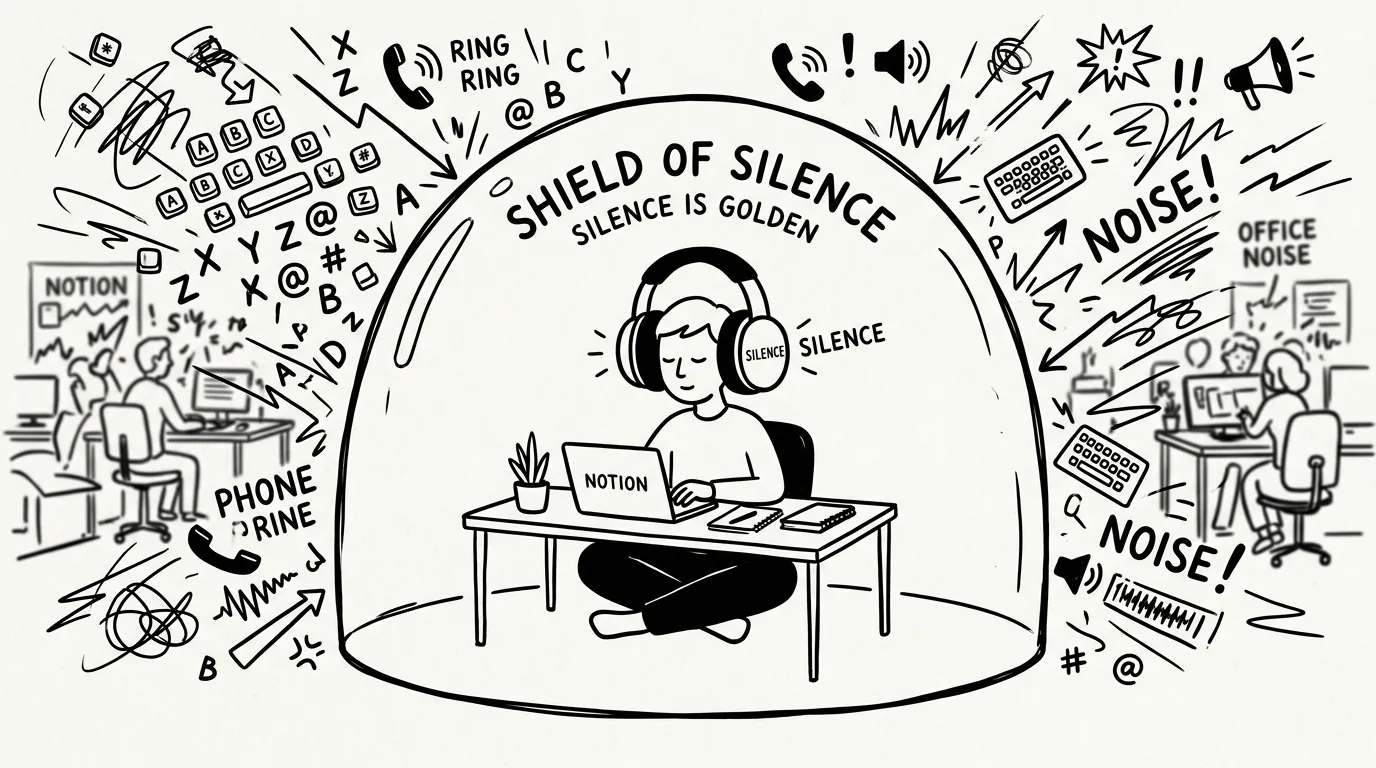
Does the sound of a coworker’s mechanical keyboard, distant chatter, or harsh white ceiling lights make you angry and unable to focus? You aren’t just being difficult; highly sensitive people (HSP) and ADHD brains have an impaired “sensory gating system.” Background noise translates into a threat. This guide shows you how to design a personal sensory buffer.
You are sitting at your desk.
Click-clack goes the mechanical keyboard next to you. The water cooler hums. Coworkers laugh three rows down. The printer spits out paper.
Your eyes are on your screen, but these environmental sounds act like invisible hands, constantly pulling your focus away from your document. The more you force yourself to “concentrate,” the more frustrated you feel. By noon, you are exhausted without having written much.
For neurodivergent individuals, the brain lacks a neural filter called “sensory gating.”
While neurotypicals easily filter keyboard clicks into background noise, our brains label every single click and flash of light as an active threat, loading it all into our awareness.
This leads to rapid prefrontal depletion. Fighting this noise when your battery is low causes sensory burnout.
We need cognitive unloading and elastic focus to protect our energy.
3 Steps to Office Sensory Survival
Since you cannot force your coworkers to be quiet or change the ceiling lights, you must build your own physical buffer zone:
1. Auditory Shielding: ANC & Masking
- Physical barrier: In a noisy room, active noise-canceling (ANC) headphones are survival gear.
- Noise Masking: Avoid lyrical pop music—it adds to your cognitive load. Instead, use the Noise Masking tool in ADHDOS to play Brown or Pink noise. Steady, low-frequency sound fills the gaps created by sudden spikes (like key taps or speech), soothing your nervous system.
2. Visual Retreat: Dampen Overhead Light
Harsh white light accelerates sensory overload.
- Keep a cap at your desk. Pull the brim low to block overhead glare.
- Set your monitors to warm tones or dark modes.
3. Somatic Reset: Cool Down Your Breathing
When noise triggers a racing heart or irritability, your body is in fight-or-flight. Drop your work for 60 seconds. Open the Breath Orb in ADHDOS. Follow its expansion and contraction for a slow “4-7-8” box breath. This physically dampens sympathetic arousal, giving your brain a quick cooldown.
The office environment doesn’t have to be a battlefield. Build your physical sanctuary, turn on Noise Masking, and let yourself focus elastically.
Quick Q&A
Why do I still hear keyboard clicks even with ANC headphones on?
ANC is great at canceling continuous low-frequency hums (like airplane engines) but struggles with sudden, sharp high-frequency noises (like typing or talking). The best fix is combining ANC with the Noise Masking background tracks in ADHDOS. The physical seal plus white noise works together to block sharp spikes.
What if coworkers think wearing headphones makes me unapproachable?
You can communicate clearly using templates from your ADHDOS Board: 'I have sensory sensitivity, and office noise makes it hard for me to focus without getting fatigued. I wear headphones to write, but please feel free to tap my shoulder or send a DM if you need me!' Most people respect clear boundaries.
Recommended Reading
When the World Is Too Loud: 3 Physical Cool-Downs for ADHD Sensory Overload
Overwhelmed by noise, light, or information? A self-care guide for sensory overload in ADHD and HSP (Highly Sensitive People). Learn 3 physical de-escalation tips and grounding techniques.
Afraid to Say No at Work? Overcoming HSP People-Pleasing and Workplace Exhaustion
Over-analyzing everyone at work and unable to say no? Discover how highly sensitive people (HSP) can set boundaries and reclaim energy.
When the Brain Power Cuts Out: A Guide to Autistic Meltdown and Shutdown Recovery
Decoding the stress responses of autistic meltdowns and shutdowns. Learn the neurological triggers and implement low-friction SOS protocols for self-rescue and support.